How a single GitHub search uncovered hardcoded credentials that could access
live guest data at hotel properties that have hosted G20 summits, heads of state,
and world leaders.
191
Data Fields Per Guest
189
Stolen Creds on Dark Web
4+
Hotel Brands at Risk
10
Months Exposed
Scroll to read the story ↓
Why This Matters Beyond Cybersecurity
The hotel Property Management System (PMS) at the center of this investigation is used by
some of the world's largest hotel chains — brands that have hosted G20 summits,
bilateral state meetings, and accommodated heads of state, diplomats, and intelligence officials.
G20 Summit VenuesHead-of-State AccommodationsDiplomatic DelegationsInternational ConferencesGlobal Hotel Chains
A breach of this system doesn't just expose tourist data — it could reveal
travel patterns, room assignments, companion details, and security arrangements
of some of the most protected people on the planet.
Scene 1
The Mistake
A contractor accidentally uploads passwords to the public internet
What happened: A software contractor building a hotel CRM integration uploaded their code
to GitHub — a public code-sharing platform. Buried inside the source code were
real production API credentials encoded as Base64 strings. The repository was public,
indexed by search engines, and visible to anyone on the internet for over 10 months.
Scene 2
The Discovery
Routine brand monitoring surfaces the exposed credentials
How it was found: During routine brand monitoring, the investigator searched public code
repositories for any references to the hotel company's API domains. Two repositories were discovered
containing hardcoded production credentials — Base64-encoded strings that decoded to
UUID-pair authentication tokens with full API access.
Scene 3
What the Key Unlocks
A single credential exposes live guest reservations in real-time
👤
Guest Names
📱
Phone Numbers
📧
Email Addresses
💳
Payment Cards
🛏️
Room Details
💰
Rates & Billing
🏢
Company Info
👨💼
Staff Names
The risk: Anyone with this credential could silently read every new hotel booking
in real-time — including guest names, phone numbers, emails, partial credit card numbers,
room assignments, and staff identities. For properties hosting dignitaries, this means
travel itineraries, room locations, and security arrangements could be compromised.
Scene 3b — Evidence
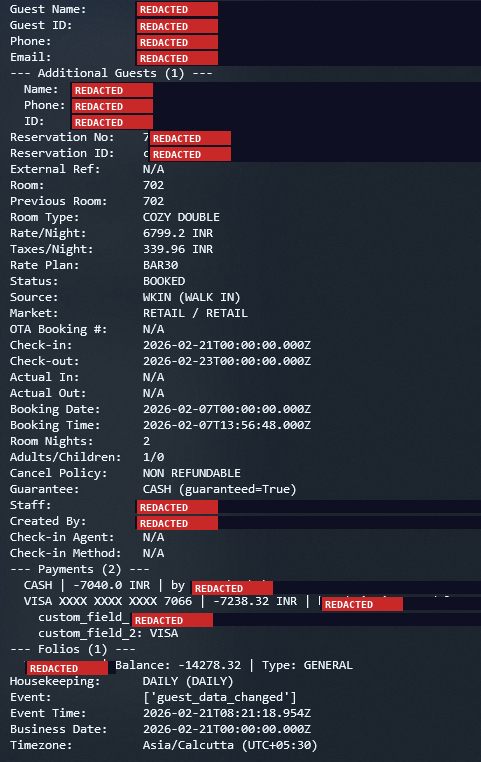
The Intercepted Data: Actual Guest Record
A real reservation record retrieved from the live DataStream — PII redacted for this publication
LIVE DATA
Actual API response — guest PII fields marked REDACTED for publication
What this screenshot shows:
👤 Guest Identity
Full name, phone number, email address, unique guest ID — plus a second guest (companion) with their own contact details.
The DataStream API delivers every new reservation event in real-time. An attacker with this credential could passively monitor all guest check-ins indefinitely.
This is not simulated data. This is an actual guest reservation record returned by the
production DataStream API using the credential found in the public GitHub repository. Guest names,
phone numbers, emails, and staff identities have been redacted. The room number, rates, dates,
and data structure are shown as-is to demonstrate the severity of the exposure.
Scene 4
The Bigger Picture
One contractor's mistake puts an entire hospitality ecosystem at risk
1
Contractor uploads credentials to public GitHub → anyone on the internet can find them
2
Stolen employee passwords found on dark web markets → hackers already have them
3
Hotel brand client credentials leaked in malware logs → downstream systems at risk
4
Security protections bypassed → direct server IPs discovered, WAF/firewall ineffective
Scene 5
The Dark Web Connection
Malware on hotel computers had already been stealing credentials
189
Leaked Creds
78
Hotel Staff
66
Infected PCs
2
Company Staff
4+
Brands Hit
Already compromised: Even before the GitHub exposure was discovered, malware had
infected hotel staff workstations and stolen their passwords. These credentials were found
circulating on dark web markets. One infected machine ("TYLER") contained credentials for
multiple hotel brands simultaneously — showing a multi-property management
station that was fully compromised.
Scene 6
The Geopolitical Dimension
Why hotel PMS security is a matter of national security
The geopolitical risk: Several hotel brands using this PMS have hosted
G20 summits, state visits, and international conferences. The reservation data
structure doesn't distinguish between a tourist and a head of state — the same 191 fields
capture room assignments, companion details, VIP flags, and security arrangements.
For a state-sponsored threat actor, this data is actionable intelligence.
Consider the scenario: A hostile intelligence service obtains these credentials.
They can now monitor, in real-time, which government officials are checking into which hotels,
which rooms they're assigned to, who is accompanying them, and how long they're staying.
This isn't hypothetical — the credentials were publicly accessible for 10 months.
Scene 7
The Resolution
Findings responsibly documented and reported for remediation
🔄
Rotate All Credentials Immediately
Change the exposed DataStream API tokens and any related secrets
🗑️
Remove or Privatize GitHub Repositories
Take down the contractor's public repos that contain production secrets
🔒
Add IP Allowlisting to APIs
Restrict DataStream API access to only authorized IP addresses
📋
Audit All Contractor Access
Review what credentials contractors hold and enforce secrets management policies
🔔
Enable GitHub Secret Scanning
Set up automated alerts for any future credential leaks across all of GitHub
Outcome: All findings were documented with forensic-quality evidence — screenshots,
timestamps, and chain-of-custody records — and reported to the client through authorized channels.
The goal: help them fix these problems before a malicious actor exploits them.